GUIDES
How to Make Balanced Golf Foursomes
Nothing sours a weekly game faster than groupings that feel rigged: the same stacked foursome winning three weeks running, or the same two guys "randomly" paired every Saturday. Balanced foursomes make the money game fair and the group feel like one instead of four cliques sharing tee times. Here's how commissioners build them.
First: balance on course handicap, not index
Before any method works, use the right number. A player's course handicap — the index converted for the tees played (Index × Slope ÷ 113, adjusted for rating minus par) — predicts strokes on this course. Two 12.0 indexes playing different tees can differ by two or three strokes. Our free spreadsheet template converts the whole roster to course handicaps in one column.
Method 1 — The ABCD snake draft
The classic, and still the best default for 3+ groups:
- Rank this week's field by course handicap, low to high.
- Split it into four tiers: with 12 players, the top 3 are your A players, next 3 are B, then C, then D.
- Deal one player from each tier into each group but snake the order: Group 1 gets the best A, Group 2 the next A, then reverse direction for the B tier so the group with the best A gets the worst B, and so on.
The snake is the trick. Deal tiers in the same order every time and Group 1 quietly gets the best of every tier. Snake it and the totals come out nearly even without fiddling. It works for team games (each group is a team) and for pace (every group has a player who keeps things moving).
Method 2 — The balanced-average check
However you build the groups, verify them the same way: sum or average each group's course handicaps. For a typical weekly field, group averages within 2–3 strokes of each other is balanced. A bigger gap means the team game is decided before anyone tees off. This check turns "feels fair" into "provably fair" when someone grumbles at the 19th hole because you can show the numbers.
The template's Pairings tab computes each group's average automatically as you assign players, so you can nudge one swap at a time until the averages line up.
Method 3 — Balance the golf, then the people
Handicap math gets you groups that are fair but not groups that are fun. The experienced commissioner's second pass:
- Rotate partners. Over 4–6 weeks, everyone should play with everyone. Keep an eye on recent pairings and break up any twosome that's ridden together three straight weeks.
- Honor the occasional request — brothers-in-law visiting, a new member who knows exactly one person — but as the exception. Standing requests become cliques.
- Mind pace and temperament. Spread the fast players around, and don't put your two hotheads in the same cart. Ever.
- Put new members with your ambassadors for their first few weeks — the members who make people want to come back.
The mistakes that make groupings feel rigged
- Pure random draw. Random is fair on average but lopsided almost every week, and lopsided is all anyone remembers.
- Commissioner always in the "good" group or always with the same partner. You're watched more closely than anyone. Snake yourself like everyone else.
- Stale handicaps. Balancing on April's numbers in August rewards whoever improved most. Keep indexes current.
- Rebuilding from scratch after every dropout. One late scratch usually needs one swap, not a reshuffle that ruins the pairings everyone already saw.
Or drag, drop, done
This whole process — course handicaps computed for this week's tees, live group averages while you drag players between tee times, recent-pairing history so rotation isn't guesswork — is what GolfCommish's grouping builder does in a couple of minutes:
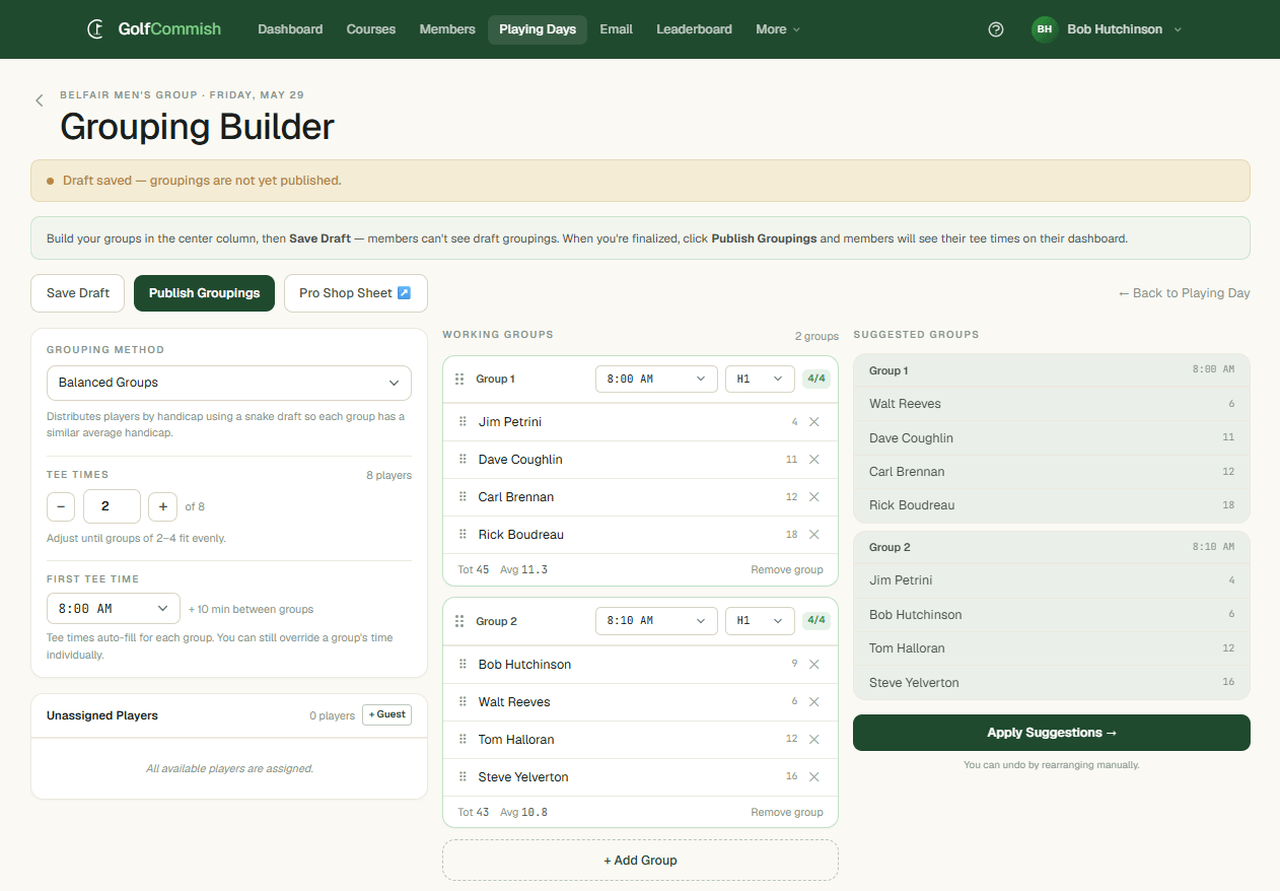
The grouping builder: available players on the left, tee-time groups on the right, handicaps and averages live.
When you're happy with the groups, the same screen emails the pairings to your members and a clean tee sheet to the pro shop — see the sample emails it sends.
Frequently asked questions
How do you split golfers into fair teams by handicap?
Rank the field by course handicap, split into A/B/C/D tiers, and snake-draft one player per tier into each group. Then check that each group's average course handicap is within 2–3 strokes of the others.
Handicap index or course handicap?
Course handicap — the index converted for the tees actually being played. Two players with the same index can differ by multiple strokes at the same course from different tees.
How often should partners rotate?
Everyone plays with everyone over 4–6 weeks. Track recent pairings and prioritize combinations that haven't happened lately — fixed cliques are the quiet killer of weekly groups.
KEEP READING
Build this week's groups in minutes
Try the grouping builder on real demo data, or set up your own group — every plan starts with a free 30-day trial. No credit card.